
Our tale begins with some beautiful yarn. Some old (40+ years!) and some new (2024) and some in between.
The main character, purchased in 2020, was a yarn with an organic depth of color and an aristocratic pedigree of 50% wool, 25% silk and 25% alpaca. Only a Noro Yarn could pull off such sophistication and this was the worsted weight Tennen in color 34 (now discontinued).

Tennen was joined by a mixed bag of yarn in brights and not so brights. This supporting cast was generally of a fingering weight and most were single plies. The purples (cochineal over indigo), gold (marigold) and khaki (field aster) yarns were the oldest of the lot and, being hand spun and naturally dyed, claimed their own stake of being yarny aristocracy.

So in the fall of 2024 I had come to knit several projects using multiple strands held together to create the mottled fabric called “marling”. Several caps ensued. But still the marled knit fabric fascinated me and I brought together this cast of characters.
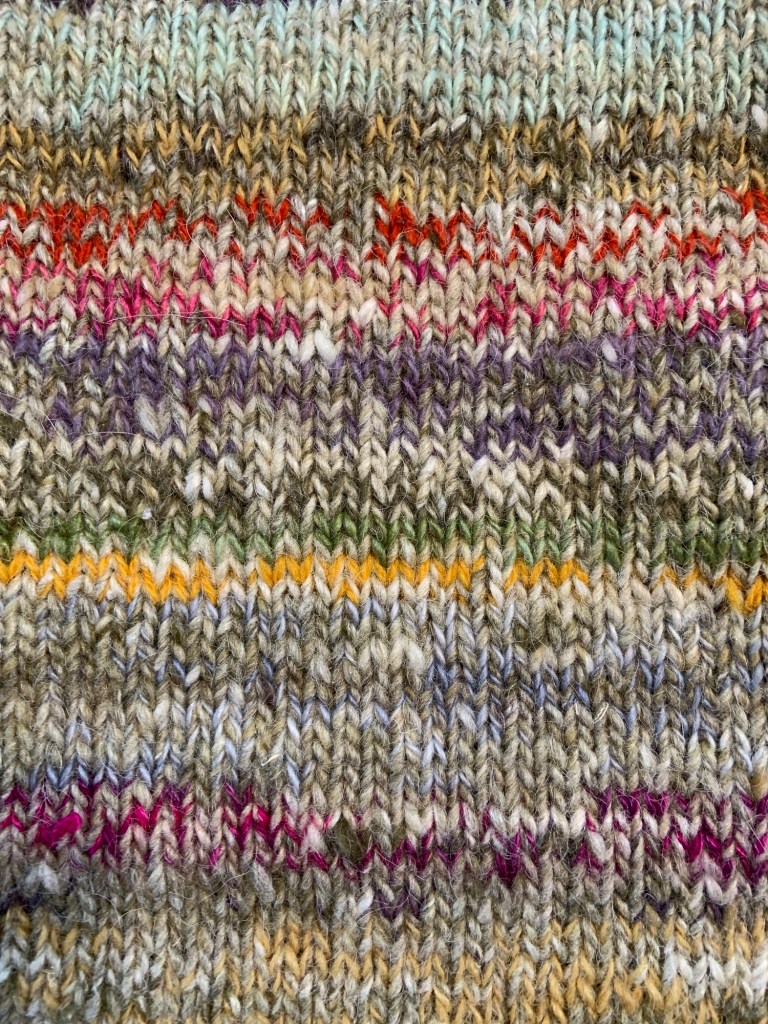
Tennen embraced the fingering yarns unequivocally and the combinations yielded some glorious stripes that faded in and out of existence. The yarns were happy and played well together. The Yarn Gods smiled.
With the sample swatch sorted and carefully measured I was ready to calculate my CO amount. I was working the sweater from the bottom up and this was not a daunting task for me.
Little did I know then what was to come!
Well I did, actually know what was to come as I’ve knitted many sweaters before. This time however, I set myself a challenge by choosing a raglan sleeve. I had never knit one before, but I had found a simplified and scalable formula to make one by the well known Norwegian knit designers, Arne and Carlos. I felt up to the task and excited by the prospect of a new sweater. I hadn’t knit one for myself in years.
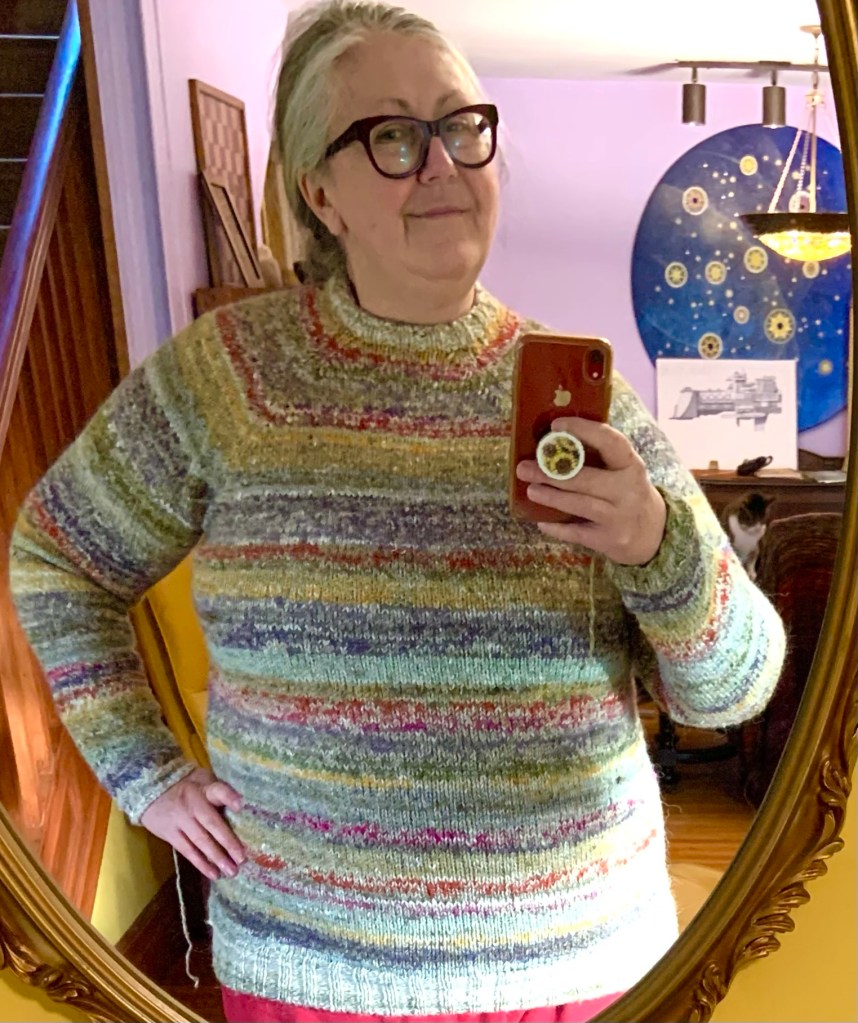
And here she is!
I had diligently followed the raglan decrease instructions as presented. I made my own calculations for the sleeve increases and length. I found it a bit snug on my, ahem, girth but banished that teensy Wendy misgiving by telling myself that some blocking or just wearing it would do the trick.
As the Newfoundland winter wore on, I wore the sweater a couple of times and both times could not deny that I started out with a snug sensation and ended the day with an overwhelming feeling of annoyance.
There was no avoiding the Truth. The sleeves were too tight throughout their entire length AND too short! Unforgivable! The armpits were too tight. Yikes! And the neckline in the front rode up incessantly. No matter that it was nice and warm too, I would never reach for the wretched thing as it was.
Sigh.
Tears. (not really but almost)
Placing the awful thing in the timeout basket.

And so began the Grand Reknitting. I put it off for a season but in the back of my mind I knew I still had work to do before it was a cozy friend that I reached for in the Canadian winter.
So in the spring I girded my loins and resolved to end what I had begun.
I started out boldly! Both sleeves were cut off at the armpit, unraveled, and then reknit downward keeping all of their width until the forearm when a few decreases were made.
The neck was unpicked and it and the entire yoke were frogged to the armpit. I had had a moment of concern about the every other row decreases for the raglan sleeve shaping but had squelched my concern and followed the directions. This led to decreases that occurred too sharply which yielded a yoke that just didn’t produce enough ease for a larger (3X) person. I reasoned that I was able to don the sweater so drastic changes were not necessary. Thus, it came to pass that I reknit the yoke, this time decreasing every third row instead of every second (or other) row. Eureka! This did the trick and provided some much needed ease without becoming oversized.
The German short rows I had originally worked for the neck shaping were woefully inadequate. I abandoned them without another thought and instead reworked the neck with some central bind off stitches.
I did not like the ribbing at the neck, cuffs and bottom, either, so I flung those to the wind also! Huzzah! The neck received a funnel treatment with a folded stockinette hem of just Tennen and the sleeves and bottom also received the treatment but with the Tennen folded to the back only.

And now it’s a comfy sweater I will wear for years to come. How lucky for me that in the knitting craft you can undo your mistakes and make them right without ruining your supplies.

Epilogue:
No kitties were harmed in the making or remaking of this sweater. Sweater is now 100% human and kitty approved.

 Lizzie Knitzz